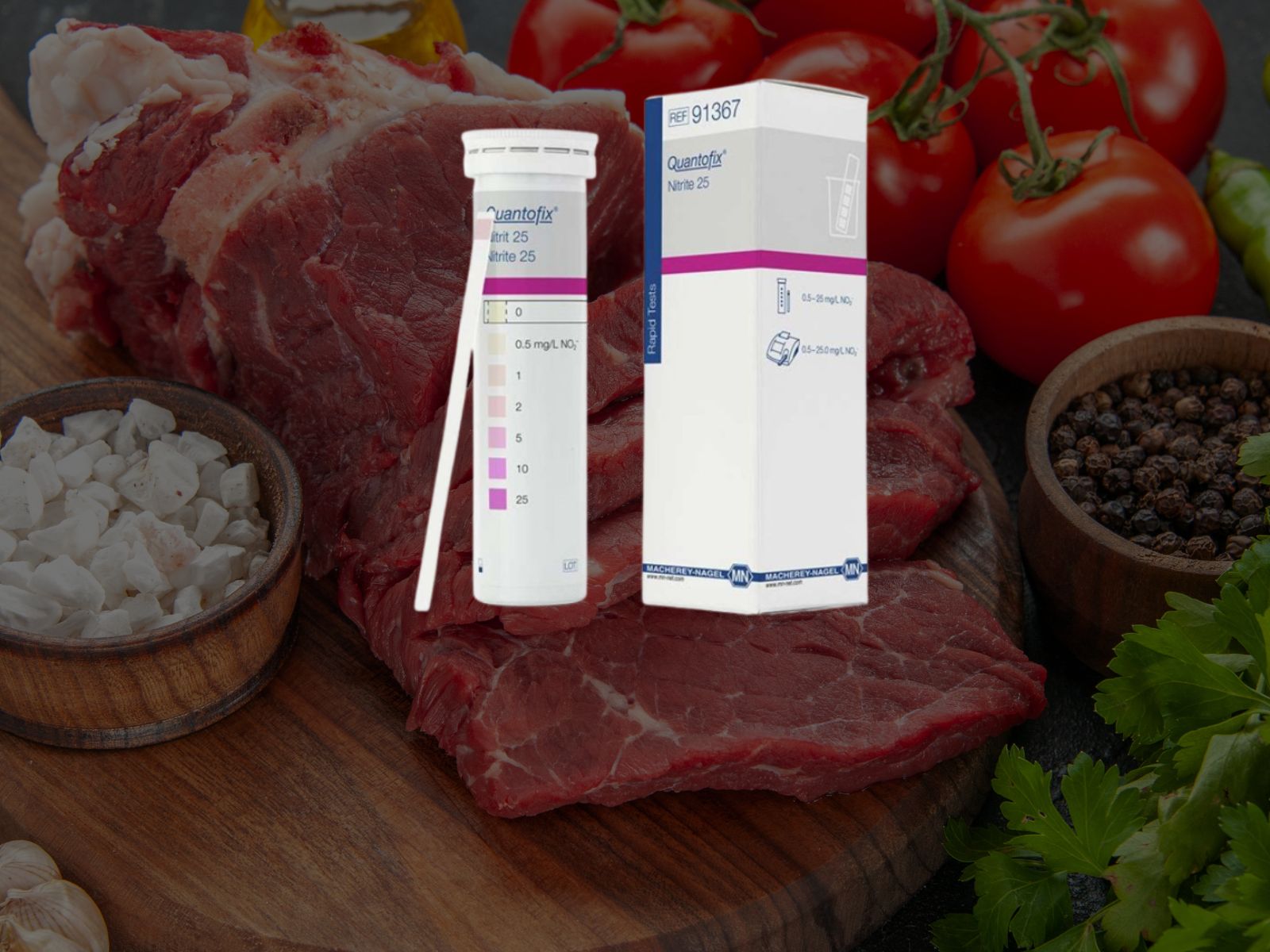
Nitrate and nitrite monitoring is a critical control point across food, agriculture, and water systems. While nitrate is an essential nutrient for plant growth, elevated concentrations pose well-documented health and regulatory risks. Nitrite, a more reactive intermediate, is of even greater concern due to its direct involvement in methemoglobinemia and the formation of nitrosamines in food products.
International guideline values highlight why fast, on-site screening matters. The World Health Organisation (WHO) sets a guideline value of 50 mg/L nitrate (NO₃⁻) in drinking water (equivalent to 11.3 mg/L nitrate-nitrogen, NO₃-N), while the U.S. Environmental Protection Agency (EPA) enforces a regulatory limit of 10 mg/L NO₃-N (≈44.3 mg/L NO₃⁻). For nitrite, limits are significantly lower due to its higher toxicity. These thresholds demonstrate the need for routine, rapid checks to prevent issues from escalating into compliance failures or product recalls.
This is where QUANTOFIX® Nitrate 250 functions as a complementary testing pair — enabling fast screening across the full nitrogen cycle in food and water systems.
QUANTOFIX® Nitrate 250: Wide-Range Screening Where It Matters
QUANTOFIX® Nitrate 250 is designed for semi-quantitative, dip-and-read nitrate analysis at the point of use.
Key technical features
- Platform: Semi-quantitative test strips
- Visual gradation: 0 • 5 • 10 • 25 • 50 • 100 • 250 mg/L NO₃⁻
- Instrumental range: 4–250 mg/L NO₃⁻ with QUANTOFIX® Relax reflectometer
- Reaction colour: White → red-violet
- Time to result: ≤ 60 seconds
- Shelf life: Typically 2 years (cool, dry storage)
- Safety & sustainability: Non-hazardous reagents; packaging now produced from recycled material
The measuring range intentionally spans the most policy-relevant concentrations — including the 50 mg/L WHO guideline — while extending to 250 mg/L for high-load scenarios such as fertiliser runoff, concentrated process streams, or raw agricultural inputs.
QUANTOFIX® Nitrite 25: Detecting the More Critical Analyte
Nitrite often appears at much lower concentrations than nitrate but carries higher toxicological significance. QUANTOFIX® Nitrite 25 enables sensitive screening where even small excursions matter.
Typical capabilities
- Detects nitrite in the low mg/L range relevant to food safety and drinking water control
- Rapid visual or reflectometric evaluation
- Ideal for identifying nitrite spikes that may interfere with nitrate measurements or signal processing issues
Used together, Nitrite 25 and Nitrate 250 provide a complete nitrogen screening solution, allowing operators to distinguish between nitrate accumulation and active nitrite formation.
Why Semi-Quantitative Test Strips Make Sense (Data-Driven Rationale)
- Speed and throughput
Each test delivers results in about 60 seconds, allowing a single operator to screen multiple samples in minutes. In food production and agriculture, this speed translates directly into faster accept/reject decisions and reduced downtime.
- Fit-for-purpose detection window
The nitrate gradation brackets regulatory limits while extending into high-concentration ranges. This makes the strips suitable for both routine compliance screening and process troubleshooting.
- Objective evaluation option
When paired with the QUANTOFIX® Relax reflectometer, subjective colour interpretation is minimised. Reflectometric readings improve reproducibility and support internal QA documentation — an advantage during audits and supplier verification.
Test Strips vs Laboratory Methods: Clear Role Definition
On-site strips = screening and triage
QUANTOFIX strips are optimised for speed, simplicity, and decision-making at the point of need. They answer the critical operational question: Is further action required right now?
Laboratory methods = confirmation and trace analysis
Techniques such as ion chromatography (IC) — including EPA-validated methods like 300.0 and 300.1 — achieve much lower detection limits (sub-mg/L to µg/L). These methods are essential for regulatory reporting, speciation, and defensible compliance data.
Best practice is to screen routinely with test strips, then submit flagged samples for laboratory confirmation when accuracy and reporting limits are critical.
Typical Applications Across Industries
- Food & dairy processing: Monitor raw milk, whey, leafy vegetables, and process water to control nitrate/nitrite levels that impact safety and shelf life.
- Drinking water monitoring: Rapid well or distribution-system checks to flag exceedances against WHO or EPA guideline values.
- Agriculture & fertigation: Measure nitrate in irrigation water, runoff, or soil extracts to optimise fertiliser use and reduce environmental loading.
Practical Tips for Reliable Results
- Follow dip-time and reaction-time instructions precisely to maintain consistency.
- Be aware of nitrite interference during nitrate testing; manufacturer guidance includes steps for removal when required.
- Dilute samples that reach the upper limit of the scale and apply correction factors as instructed.
- Store strips correctly and log lot numbers and expiry dates as part of routine QA/QC.
A Practical First Line of Defence
For teams needing rapid, repeatable on-site nitrate and nitrite screening, QUANTOFIX® Nitrite 25 and Nitrate 250 offer a balanced combination of speed, relevant measuring ranges, and optional objective evaluation. Together, they help identify issues early — before they become costly, non-compliant, or unsafe — while integrating seamlessly into broader laboratory-based quality systems.
For food safety, agriculture, and water monitoring programs, this power duo delivers clarity where timely decisions matter most.
For Further Enquiry Contact: sales@vendart.com.au