Arsenic remains one of the most closely monitored toxic elements in food, beverages, and industrial environments. Even at very low concentrations, chronic exposure can present serious health risks. For wineries, environmental laboratories, and industrial hygiene teams, rapid qualitative screening plays an important role in early risk detection.
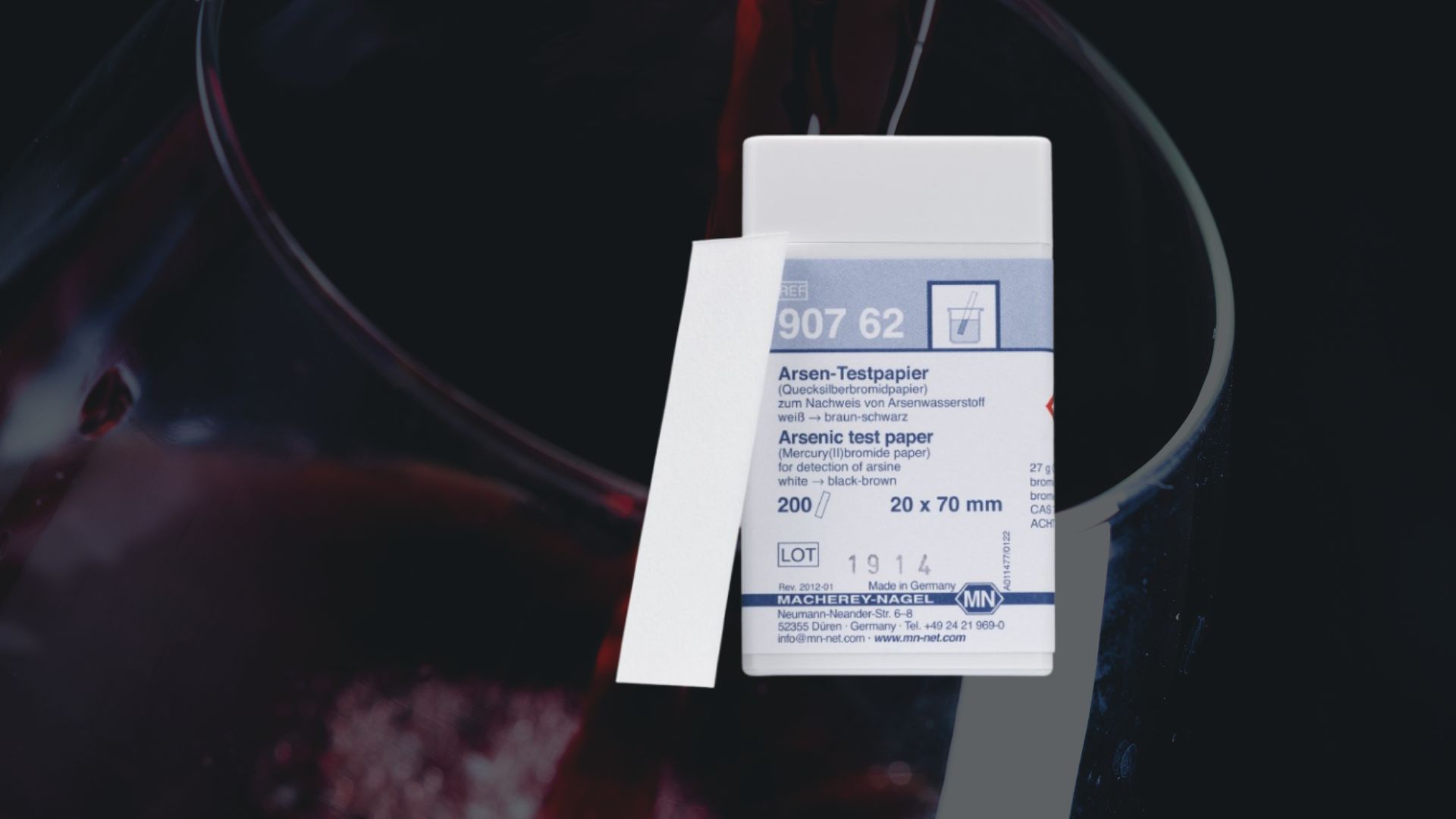
Arsenic Test Paper (mercury bromide paper) provides a straightforward method for detecting arsine (AsH₃) in the gas phase, enabling fast, visual identification without complex instrumentation.
Why Arsenic Monitoring Matters
Arsenic contamination can originate from:
- Soil and groundwater uptake
- Agricultural inputs
- Industrial emissions
- Processing equipment or raw materials
In winemaking, arsenic may enter grape must through environmental exposure. In industrial environments, arsine gas can be generated during metallurgical or chemical processes. Because arsine is highly toxic—even at very low concentrations—early detection is critical.
While advanced methods such as ICP-based analysis provide quantitative confirmation, rapid screening tools are valuable for on-site assessment and preliminary verification.
How Arsenic Test Paper Works
Arsenic Test Paper is a qualitative test strip based on mercury bromide chemistry. It detects arsine gas (AsH₃) through a visible color reaction.
When arsine comes into contact with the test paper:
- The strip changes from white to brown-black
- The intensity of the color corresponds to the presence of arsenic
It is important to note:
- The test works only in the gas phase
- The strip must not be dipped directly into solutions
For liquid samples, arsenic must first be chemically converted into arsine gas before detection.
Application in Grape Must and Wine
In oenology, arsenic testing supports quality control and safety verification. To test grape must or wine:
- Arsenic in the solution is chemically reduced using zinc and hydrochloric acid.
- The reaction generates arsine gas.
- The gas is purged from the solution and exposed to the test paper.
- Any arsenic presence triggers a brown-black discoloration.
This method allows wineries to screen samples quickly before proceeding to advanced laboratory analysis.
Air Monitoring for Arsine
In industrial hygiene applications, the test paper can detect arsine directly in air samples.
Procedure:
- Moisten the strip with acetic anhydride before use.
- Expose it to the air sample.
- Observe any color change.
This provides a practical screening tool in environments where arsine formation is possible, such as metal refining, semiconductor production, or chemical processing facilities.
Technical Specifications
The Arsenic Test Paper is designed for practical field and laboratory use:
- Platform: Qualitative test paper
- Detection limit (Arsenic): 0.5 µg arsenic
- Detection limit (Oil parameter): 5 mg/L
- Color change: White → Brown-black
- Dimensions: 70 mm length × 20 mm width
- Shelf life: 2 years from production
- Storage temperature: 4–30 °C
- Scope of delivery: 200 test strips in a plastic box
- Gross weight: 50.8 g
- Packaging dimensions: 48 × 25 × 84 mm
- Hazard classification: Hazardous material
A detection limit of 0.5 micrograms of arsenic makes it suitable for identifying low-level contamination during screening processes.
Operational Advantages
1. Rapid Visual Results
No instrumentation is required. The result is immediately visible through a distinct color shift.
2. Cost-Effective Screening
Ideal for routine monitoring before committing to laboratory-based quantitative analysis.
3. Portable and Lightweight
With 200 strips per compact box, it is suitable for fieldwork, wineries, and industrial inspections.
4. Two-Year Shelf Life
Provides long-term usability when stored correctly in cool, dry conditions.
Proper Storage and Handling
To maintain performance integrity:
- Store in a cool, dry place
- Avoid exposure to sunlight and moisture
- Keep within the recommended temperature range of 4–30 °C
Because the product contains mercury bromide, it is classified as a hazardous material and must be handled and disposed of according to local safety regulations.
When to Use Arsenic Test Paper
This product is particularly valuable for:
Wineries and Oenology Laboratories
- Screening grape must before fermentation
- Verifying arsenic absence in finished wine
- Supporting compliance and export documentation
Environmental & Industrial Monitoring
- Detecting arsine in the air
- Evaluating workplace safety risks
- Preliminary assessment before instrumental testing
Quality Control Laboratories
- Fast screening during sample intake
- Supporting confirmatory ICP or AAS analysis
Screening vs Quantitative Analysis
Arsenic Test Paper provides qualitative detection, not numerical concentration values. For regulatory reporting or precise quantification, laboratory-based techniques such as ICP-MS or AAS remain essential.
However, qualitative screening offers measurable operational benefits:
- Faster decision-making
- Reduced laboratory backlog
- Early contamination detection
- Lower testing costs for routine checks
This layered approach—rapid screening followed by confirmatory analysis when required—strengthens overall risk management.
Supporting Analytical Confidence in Australia
Vendart supplies specialised analytical and quality control tools to laboratories and production facilities across Australia. By offering practical solutions like Arsenic Test Paper, Vendart enables rapid screening without sacrificing scientific reliability.
Local supply ensures accessibility, technical support, and alignment with industry standards across food, environmental, and industrial sectors.
A Practical Safeguard Against Arsenic Risk
Arsenic contamination—whether in grape must, wine, or industrial air—demands vigilance. Arsenic Test Paper provides a straightforward, data-backed screening method capable of detecting arsenic at 0.5 µg sensitivity.
For organisations seeking a reliable first-line detection tool, this gas-phase qualitative test offers speed, portability, and operational simplicity.
In environments where trace toxic elements can have significant consequences, rapid screening is not just convenient—it is a critical control measure.
For Further Enquiry Contact: sales@vendart.com.au